

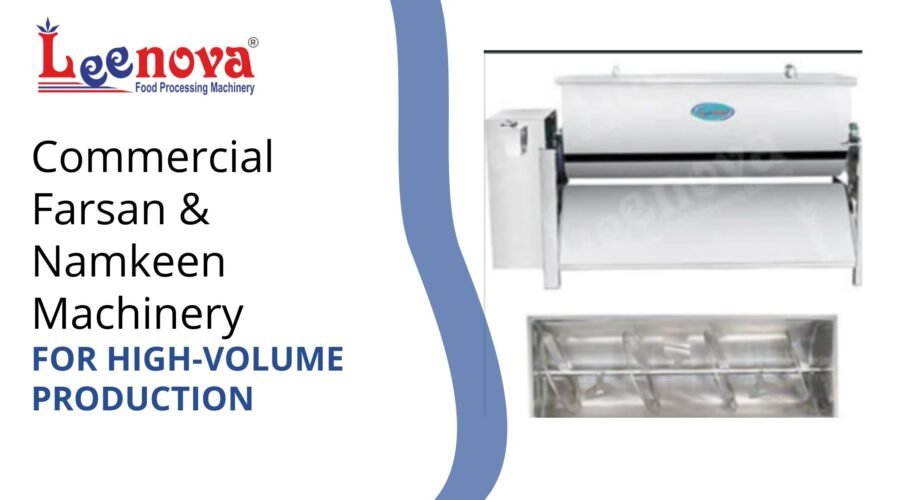
Most Farsan and namkeen units hit a ceiling long before demand does. Labour-heavy frying, uneven product shape, and slow batch turnover quietly cap daily output, even when orders keep growing. The gap usually isn’t in recipes but in machinery: mixers that can’t handle tight besan dough, extruders that vary thickness, and fryers that waste fuel and oil. Commercial Farsan and namkeen machinery fixes these choke points by standardising mixing, shaping, frying, and seasoning at scale. This guide explains the main machine types, how to think about kg/hr capacity, what features actually impact your margins, and how to size a line that can run long hours without breaking your team or your oil bill. It is written for shop owners, snack brands, and cloud kitchens planning serious volume growth.
Overview of Farsan and namkeen machinery
High-volume namkeen production rests on a few core machine groups that replace manual steps while keeping control in your hands. The usual building blocks are:
- Flour and dough mixers
- Namkeen / Farsan extruders
- Batch or continuous fryers
- Masala mixers / seasoning drums
- Conveyors and cooling setups
Semi-automatic setups keep loading and unloading manual but mechanise mixing, extrusion, and frying temperature control. Fully integrated plants join these into a continuous line, reducing handling and making hourly output predictable.
Production capacity and output planning
Capacity bands and real daily output
Vendors often quote impressive kg/hr numbers that assume ideal conditions and one product. In practice, you should plan using:
- 50–100 kg/hr: micro units, local shops, 1–2 flagship items
- 100–300 kg/hr: growing brands, multiple SKUs, festival spikes
- 300+ kg/hr: city-level distribution, contract packing, exports
A plant rated 150 kg/hr rarely runs at that exact load all day. Changeovers, cleaning, and dough resting cut 20–30% of usable time. For planning, work back from your peak-season kg/day target and then choose a line that can hit that within 6–8 running hours, not 12–14.
Key features in Farsan and namkeen machines
Construction and materials
Farsan doughs are stiff, oily, and abrasive. That means machines must use:
- SS304 in all food-contact parts for hygiene and corrosion resistance
- Heavy-gauge frames that resist vibration during continuous extrusion
- Industrial bearings and gearboxes sized for dense dough loads
This is where cheaper, thin-sheet builds fail first: gear wear, frame flex, and misaligned dies that ruin product shape.
Automation and controls
Simple controls do more work than complex panels most operators avoid. Focus on:
- Variable speed drives on extruders and conveyors to fine-tune thickness and fry time
- Digital temperature controllers on fryers with clear setpoint and actual readouts
- Oil circulation and filtration loops that keep crumbs out and colour stable over long runs
These controls reduce operator guesswork, which is often the real cause of inconsistency between early-morning and late-evening batches.
Mixer, extruder, and shaping systems
Dough and flour mixers
A Farsan line lives or dies on dough consistency. Commercial mixers for namkeen should:
- Handle 20–200 kg/batch depending on your daily volume
- Mix besan, spices, and oil uniformly without “dead corners” in the drum
- Offer tilting or discharge systems that empty the full batch quickly
Under-sized mixers force multiple small batches and introduce recipe drift as staff “adjust by feel” across the day.
Namkeen and Farsan extruders
Extruders convert dough quality into saleable shape. Look for:
- Interchangeable dies for sev, gathiya, bhujia, papdi, boondi, and special shapes
- Single-screw or rotary designs matched to your main product family
- Motors sized for continuous rope or pellet formation without frequent stalling
A useful rule: if an extruder needs two staff members to keep feeding and handling output, its effective capacity is already mismatched with your fryer.
Frying systems for high-volume production
Batch fryers
Batch fryers still work well when you:
- Run 50–150 kg/hr with many SKUs
- Need frequent oil changes due to heavy spice loads
- Prefer human judgement for colour and expansion
Rectangular or circular pans with proper baffles, chimneys, and baskets can be very productive when matched to the right batch size. The risk is inconsistency when operators change.
Continuous fryers
Continuous fryers become essential when you:
- Cross ~200 kg/hr on your main items
- Want uniform residence time in hot oil
- Need to cut labour per kg
These systems use conveyor belts or submerger belts to carry product through a controlled oil path. Proper oil flow, skimming, and filtration help you maintain colour, flavour, and FFA levels more easily than with multiple scattered kadais.
Seasoning, mixing, and handling
Masala coating and mixing
Post-fry masala coating is where many units lose money through uneven taste and high breakage. Purpose-built seasoning mixers:
- Use ribbon or octagonal drums to tumble product gently
- Allow controlled masala dosing rather than hand-sprinkling
- Shorten the time between frying and packing, sealing in crispness
Even a modest-capacity drum can stabilise flavour across the day and reduce customer complaints about “today’s batch tasting different”.
Conveying and cooling
Hot namkeen packed too early sweats, softens, and breaks in transport. A basic but effective handling chain includes:
- Mesh conveyors or trays for oil drain-off
- Ambient or forced-air cooling to reach packing temperature
- Simple transfer chutes that avoid long drops and chipping
This part of the line does not look glamorous, but it often determines your actual shelf life and claim rate.
Hygiene, safety, and compliance
Food safety design
High-volume plants must clean fast between shifts and SKUs. Good design features include:
- Smooth welds, radiused corners, and no blind pockets in mixers and fryers
- Tool-less access panels so staff can reach internal surfaces easily
- CIP-friendly layouts where hoses and food-safe chemicals can cover critical zones
If cleaning takes too long, teams start skipping steps, and that shows up as rancid flavours and micro issues long before you see visual dirt.
Operator and plant safety
Hot oil, moving screws, and heavy drums all pose risks without basic safeguards:
- Guards around rotating parts and drive belts
- Emergency stop switches within easy reach along the line
- Proper earthing, MCB protection, and gas/fuel safety practices
These are not just compliance points; a single incident can shut a plant for days and unsettle staff.
Layout, utilities, and manpower
Plant layout considerations
A Farsan layout should follow the natural process:
- Raw material and flour storage
- Mixing and dough preparation
- Extrusion and feeding to fryer
- Frying and de-oiling
- Seasoning and cooling
- Weighing and packing
Keep raw and finished product paths separate. Allow clear aisles for sacks, trolleys, and cleaning staff. Tight corners and crossflows always show up as spillage and rework.
Utilities and manpower planning
Before finalising machinery, map:
- Connected load (kW) and available power
- Fuel type for fryers (electric, diesel, gas, wood) and its local availability
- Realistic staffing per shift for feeding, monitoring, cleaning, and packing
Well-chosen semi-automatic lines often outperform cheap “fully automatic” setups because they match the actual skills and utility constraints of the site.
Buying criteria and common mistakes
What to evaluate before purchase
Create a short, concrete checklist:
- Daily kg/day target by product category
- Main SKUs (sev, gathiya, bhujia, mixtures, etc.) and expected mix
- Required automation level and available operators
- Space, power, and fuel constraints at your site
Then look at each machine for build quality, SS grade, access for cleaning, and simple, service-friendly controls.
Mistakes to avoid
Common pitfalls include:
- Selecting only on lowest price and then overspending on fuel, oil, and breakdowns
- Ignoring kg/hr alignment and ending up with bottlenecks at mixer or fryer
- Underestimating spares and service support, especially outside metro cities
- Buying oversize continuous systems for very diverse, low-run SKUs where flexibility matters more than raw capacity
A slightly “under-automated” but robust line often delivers better ROI than a complex plant staff cannot maintain.
Conclusion
Commercial Farsan and namkeen machinery is not just about going faster; it is about making every kilogram more predictable, more consistent, and easier to scale. If you are planning an upgrade or a new plant, list your daily kg, key products, and space constraints, then choose machines that fit those numbers, not just a catalogue page.
Leenova Kitchen Equipments designs and manufactures commercial Farsan and namkeen machinery tailored to Indian snack producers, from semi-automatic shop setups to higher-capacity integrated lines. With food-grade stainless steel builds, practical controls, and service-focused support, Leenova’s aim is to help you move from labour-heavy, batch-bound production to stable, high-volume output without losing your signature taste. Share your current and target production volumes, and the Leenova team can recommend a mixer–extruder–fryer–seasoning configuration that fits your floor, your fuel, and your growth plans.