

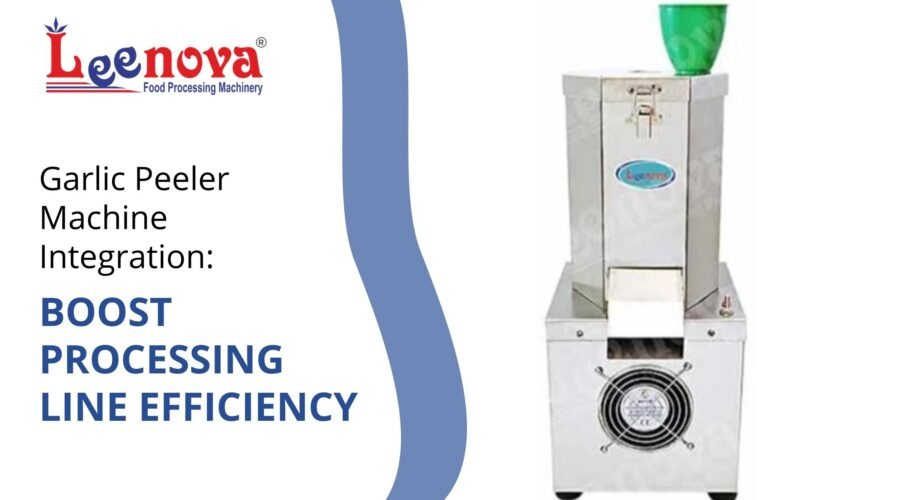
Food processing lines lose the most efficiency at manual bottlenecks. Garlic peeling operations create the worst delays—processors handling 200-500 kg daily spend 40-50% of total production time on this single task when done manually or with standalone batch machines. Workers peel, inspect, and sort while downstream cutting, washing, and packaging equipment sits idle waiting for material flow. An integrated garlic peeler machine transforms this bottleneck into continuous throughput. Full processing lines with automated feeding, peeling, separation, and discharge systems can handle 100-2000 kg per hour with 2-3 operators versus 15-20 workers for equivalent manual capacity. As commercial kitchen equipment manufacturers since 2006, we design garlic processing solutions that integrate with existing production workflows. This guide explains how garlic peeler integration works, the components involved, efficiency gains, capacity matching, and what distinguishes effective integration from simple machine placement.
How Integration Works
Automated Feeding System
Integrated lines begin with conveyor-fed input rather than manual batch loading. Workers dump bulk garlic onto an elevator conveyor that regulates flow into a bulb separator—the first automated stage that breaks whole garlic heads into individual cloves.
This continuous feeding eliminates the start-stop pattern of batch peelers where operators load, wait, unload, then repeat. Material flows steadily through each processing stage without queue buildup or idle time.
Sequential Processing Stages
A complete integrated line moves garlic through connected stations:
- Bulb separation – breaks whole garlic into cloves automatically
- Pneumatic peeling – removes skin using compressed air in continuous or batch chambers
- Air separation – sorts peeled cloves from skin debris using cyclone or vacuum systems
- Inspection conveyor – allows quality checks and manual touch-up without stopping flow
- Washing – removes residual skin particles and prepares for downstream use
- Air drying – eliminates surface moisture for storage or further processing
Each stage feeds directly into the next, maintaining continuous flow rather than discrete batch operations.
Efficiency Benefits
Labor Reduction
Integrated peeling lines reduce labor requirements by 70-85% compared to manual operations. A 500 kg/hour line operates with 2-3 workers handling feeding, inspection, and packaging—tasks requiring judgment that machines cannot perform.
Manual processing of the same 500 kg requires 18-20 workers spending their entire shift on repetitive peeling. The labor cost difference exceeds ₹30,000-40,000 daily at standard wages, creating monthly savings of ₹900,000-1,200,000.
Throughput Improvement
Continuous feeding increases actual processing capacity by 35-45% compared to equivalent batch capacity. A 200 kg/hour batch peeler running cycles of load-peel-unload achieves only 120-140 kg/hour effective throughput due to handling time.
The same 200 kg/hour capacity in an integrated line maintains 190-200 kg/hour effective output because material flows continuously. This difference compounds over 8-hour shifts—1,520-1,600 kg versus 960-1,120 kg daily production.
Product Quality Consistency
Automated processing delivers 95-98% peeling consistency across all cloves versus 75-85% for manual operations. Machines apply uniform pressure and timing to every piece, eliminating the variation from worker fatigue, skill differences, or attention lapses.
Higher consistency reduces rejection rates in downstream processing. Slicing or dicing equipment performs better with uniformly peeled cloves that lack skin fragments causing blade wear or product contamination.
Integration Components
Bulb Separator Stations
Bulb separators break garlic heads into individual cloves without damage using rotating rubber cups or pneumatic splitting. This automated separation replaces manual breaking that takes 8-12 seconds per bulb and causes hand strain.
Separation capacity must match or exceed peeling capacity to prevent bottlenecks. A 500 kg/hour peeling line requires 500-600 kg/hour separation capacity accounting for efficiency losses and bulb density variation.
Pneumatic Peeling Chambers
Industrial peeling chambers process material continuously or in rapid batch cycles—typically 15-30 kg every 20-30 seconds. Multiple chambers operating in parallel maintain steady output flow.
Chamber design affects peeling efficiency and clove damage rates. Properly engineered chambers achieve 92-98% peeling success with under 3% clove damage. Poor designs drop to 75-80% efficiency with 8-12% damage, negating integration benefits.
Separation and Sorting Systems
Air cyclones or vacuum separators remove peeled skin from cloves using density differences. Lightweight skin gets drawn into collection bins while heavier cloves continue on conveyors to inspection stations.
Some systems add optical sorting using cameras and air jets to remove discolored, damaged, or partially peeled cloves automatically. This reduces manual inspection labor by 60-70% while maintaining quality standards.
Capacity Matching
Small to Medium Scale (100-300 kg/hr)
Food processors handling 100-300 kg/hour suit simplified integration with 2-3 connected machines rather than full automated lines. A bulb separator feeding into a continuous peeler with manual collection provides 70-80% of full automation benefits at 40-50% of capital cost.
These semi-integrated setups work well for operations adding garlic processing to existing production versus dedicated garlic plants.
Industrial Scale (500-2000 kg/hr)
Large processors require full integration with parallel peeling chambers, automated separation, washing, drying, and optional slicing or dicing modules. Capital investment runs ₹15,00,000-45,00,000 depending on capacity and automation level.
At these scales, integration becomes essential rather than optional. Manual handling cannot support throughput requirements, and bottlenecks anywhere in the line idle expensive equipment.
Operational Improvements
Reduced Downtime
Integrated lines incorporate buffer zones between stages that absorb temporary slowdowns without stopping the entire process. If one peeling chamber requires cleaning, parallel chambers maintain flow until service completes.
This redundancy keeps overall line efficiency at 85-92% versus 60-70% for non-integrated batch operations.
Predictive Maintenance
Modern integrated lines monitor motor load, air pressure, throughput rates, and reject percentages in real-time. Deviations from normal patterns signal developing problems before failures occur.
Early intervention prevents the cascading downtime that happens when one failed component stops the entire production schedule.
Scalability Considerations
Start with core integration—bulb separation, peeling, and basic sorting—then add washing, drying, and advanced sorting as volume grows. Modular design allows capacity expansion without replacing entire lines.
Most processors underestimate growth needs by 30-40%. Building 20-25% excess capacity into initial integration prevents premature capacity constraints that require expensive retrofitting.
FAQs
Q: What capacity increase can I expect from integrating a garlic peeler into my processing line?
A: Integrated garlic peeling typically increases effective throughput by 35-45% compared to equivalent batch capacity. A 200 kg/hr batch peeler achieves 120-140 kg/hr actual output due to loading/unloading time, while integrated continuous systems maintain 190-200 kg/hr.
Q: How many workers does an integrated garlic processing line require?
A: A 500 kg/hr integrated line operates with 2-3 workers handling feeding, quality inspection, and downstream processes. Manual processing of the same volume requires 18-20 workers, representing 85% labor reduction.
Q: What components are essential for basic integration?
A: Minimum integration includes a bulb separator, continuous or rapid-cycle peeler, and automated skin separation. Optional additions like washing, drying, and optical sorting enhance efficiency but aren’t required for basic integration benefits.
Q: Can I integrate a garlic peeler with my existing vegetable processing line?
A: Yes, garlic peelers integrate with existing conveyor systems, washing equipment, and packaging lines. Key requirements include matching conveyor heights, aligning processing speeds, and ensuring adequate floor space for garlic-specific equipment.
Q: What is the payback period for integrated garlic peeling equipment?
A: Industrial integrated lines processing 500+ kg daily typically achieve payback in 12-18 months through labor savings alone. Including yield improvement from reduced damage, payback shortens to 10-14 months for high-volume operations.
Conclusion
Integrating garlic peeler machines into processing lines increases throughput by 35-45%, reduces labor by 70-85%, and improves peeling consistency to 95-98%. The transformation from batch operations to continuous flow eliminates the single biggest bottleneck in garlic processing.
Leenova Kitchen Equipments designs garlic processing solutions for food manufacturers, commercial kitchens, and industrial processors who need efficient garlic preparation integrated into broader production workflows. While our core focus serves restaurant and commercial kitchen scales, we understand how processing efficiency affects operations of all sizes.
Our approach emphasizes practical integration—connecting garlic peeling capability with existing equipment and workflows rather than requiring complete line replacement. We help operations identify bottlenecks, match capacity requirements, and implement solutions that deliver measurable throughput improvements.
Since 2006, we’ve supplied food processing equipment to businesses across India with a focus on reliable operation, straightforward maintenance, and transparent pricing. Whether you’re processing 50 kg or 500 kg daily, integration principles remain the same: continuous flow, automated separation, and minimal manual intervention.
Ready to eliminate garlic peeling bottlenecks in your processing line? Contact Leenova Kitchen Equipments today to discuss your current workflow, capacity requirements, and how garlic peeler integration can boost your overall processing efficiency.