

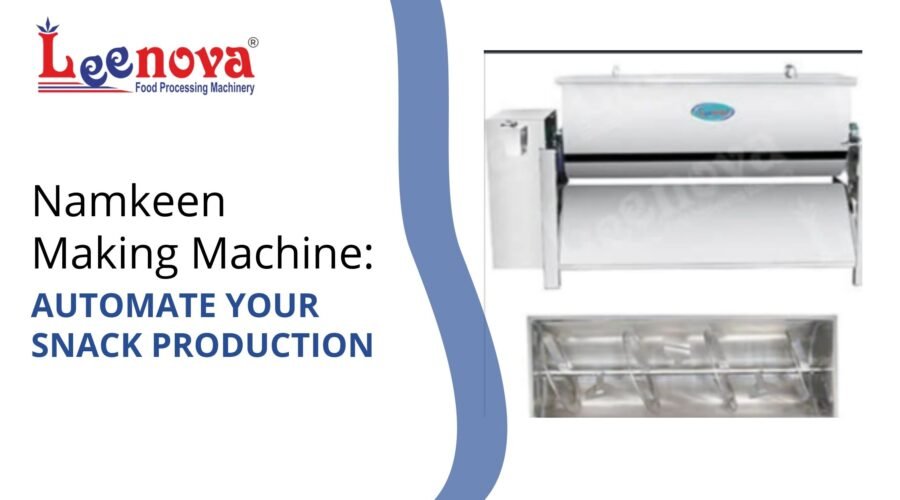
Manual namkeen production hits a ceiling fast. A skilled worker fries 20-30 kg of sev or bhujia per hour while managing dough consistency, oil temperature, and seasoning by feel—any variable slips and the whole batch does too. Festival season orders, wholesale contracts, and retail tie-ups all demand output that hands and kadais simply cannot deliver at consistent quality. A namkeen making machine breaks this constraint by mechanising mixing, extrusion, frying, and seasoning into a repeatable, scalable process.
This guide covers the production stages you need to automate, the machine types that handle them, capacity bands for different business sizes, and the real-world features that determine whether a machine pays back in months or collects dust. It is written for namkeen unit owners, farsan shop operators, and snack brands planning to move from kitchen-scale to commercial-scale production.
Understanding namkeen production process
Every namkeen product follows the same five-stage sequence regardless of recipe:
- Mixing: Besan, spices, oil, and water combine into a uniform dough
- Extrusion: Dough passes through dies to form sev, bhujia, gathiya, or boondi shapes
- Frying: Extruded product cooks in hot oil at precise temperatures
- Seasoning: Masala, salt, and flavour coatings apply post-fry
- Cooling and packing: Product reaches ambient temperature before sealing
Manual operations manage these stages with separate workers at each station. Automated machines link them, cutting inter-stage handling time by 50-70% and removing the human variables that cause batch-to-batch taste inconsistency.
Types of namkeen making machines
Extruders and sev machines
The extruder is the heart of any namkeen line. Standard sizes in the Indian market are 7-inch and 9-inch, referring to die plate diameter:
- 7-inch models: 50-100 kg/hr output, suited to small units and shops
- 9-inch models: 100-200 kg/hr output, built for medium commercial operations
Interchangeable dies produce sev, gathiya, papdi, bhujia, chakri, and boondi shapes on the same machine. Die swaps take 5-8 minutes, making multi-SKU production practical without buying separate extruders.
Batch fryers vs continuous fryers
Batch fryers (rectangular or round pans) suit operations under 150 kg/hr with varied SKUs requiring frequent oil changes. Continuous fryers use conveyor belts to carry product through a controlled oil path, handling 200-500 kg/hr without the supervision overhead of batch systems. The continuous fryer’s real advantage isn’t speed—it’s consistent oil temperature across every piece, eliminating the colour variation that plagues large batch-fried products.
Seasoning and coating systems
Octagonal or ribbon-style seasoning drums apply masala uniformly by tumbling product at controlled speed. Hand-sprinkling masala on large batches creates flavour hotspots; drums distribute coating within ±3-5% variance across the entire batch.
Capacity planning
Match machine capacity to your peak-day output, not your daily average:
- 50-100 kg/hr: Local shops, sweet marts, and early-stage snack units
- 100-300 kg/hr: Wholesale suppliers, regional brands, multi-SKU production
- 300-500+ kg/hr: State-level distribution, supermarket supply chains, export units
A practical sizing note: rated capacity assumes single-product continuous runs. Multi-product operations lose 20-30% of effective capacity to die changes, cleaning, and oil adjustments. If your plan calls for 5-6 different namkeen varieties daily, size up by one capacity band.
Key machine features
Construction and hygiene
Food-contact surfaces must use SS304 minimum:
- Stainless steel extrusion chambers and die plates resist corrosion from spiced doughs
- Polished internal surfaces allow full cleaning between shifts without residue buildup
- Sealed motor housings prevent oil ingress during washdowns
Mild steel frames with food-safe paint fail within 18-24 months under continuous frying-area humidity.
Controls and automation
Effective controls reduce dependency on experienced operators:
- Variable speed drives (VFDs) on extruders adjust extrusion rate without stopping the machine
- Digital temperature controllers on fryers hold oil within ±2°C, preventing under- or over-frying
- Oil circulation and filtration loops extend oil life and maintain consistent flavour
Operations without these controls rely on operator judgement—the main reason morning and evening batches taste different.
Benefits of automation
Automation delivers three concrete improvements beyond raw speed:
- Labour reduction: One operator manages extruder, fryer, and seasoning drum versus 3-4 workers manually
- Waste reduction: Consistent oil temperature and controlled extrusion cut reject rates from 8-12% manual to under 3%
- Scalability: Machines run identical parameters across shifts, enabling night production without senior staff supervision
The contrarian reality: many namkeen units automate frying first but keep manual extrusion, creating a new bottleneck at the extruder. Automate the full sequence from mixing to seasoning for throughput gains that actually move the needle.
Setting up your namkeen production
Space and layout
A functional namkeen line needs a linear flow: raw material storage → mixing → extrusion → frying → seasoning → cooling → packing. Avoid crossflows where raw besan paths cross finished product areas. Budget 500-800 sq ft minimum for a 100-200 kg/hr line including raw material and oil storage.
Utilities and installation
Before ordering equipment, confirm:
- Power: Most continuous lines need three-phase 415V; extruders and batch fryers run on single-phase 220V
- Fuel: Fryer heating options include electric, gas, or diesel—each affects running cost per kg
- Water and drainage: Daily cleaning requires pressurised water and floor drains near all food-contact equipment
Cost and ROI considerations
Entry-level semi-automatic namkeen setups (extruder + batch fryer + drum) cost ₹1,20,000-₹2,50,000. Mid-range continuous lines (extruder + continuous fryer + seasoning system) range ₹4,00,000-₹8,00,000. Compare against:
- Labour saved: ₹2,40,000-₹3,60,000 annually (2-3 workers replaced)
- Waste reduction: 5-9% better yield on besan and oil costs for a 100 kg/hr unit
- Capacity expansion: ability to fulfil wholesale orders without additional shifts
Operations running above 80-100 kg daily see payback within 14-20 months. Below 50 kg daily, semi-automatic units with batch fryers offer better ROI than full continuous lines.
Frequently Asked Questions
Can one extruder machine produce all namkeen varieties?
Yes, within the same dough category. Besan-based products (sev, gathiya, bhujia, papdi) all run through the same extruder with die changes. Rice-based or corn-based products need different extruder screw configurations—confirm compatibility before purchase.
What maintenance do namkeen machines need?
Daily: clean extruder dies, flush oil from fryer baskets, wipe seasoning drums (20-30 minutes total). Weekly: inspect die plates for wear, check VFD settings, clean oil filtration units. Monthly: lubricate bearings, inspect heating elements. Budget 6-8% of purchase price annually for upkeep.
How do I handle multiple SKUs without separate machines?
Use interchangeable die sets on a single extruder and run similar products in sequence. Start with plain sev, then masala sev, then bhujia—flavour carryover is minimal with a quick rinse between runs. Completely different dough types (besan vs rice flour) need a full clean between production runs.
Is three-phase power necessary?
Batch fryers and small extruders run on single-phase 220V. Continuous fryers above 200 kg/hr and integrated automated lines require three-phase 415V. Adding three-phase infrastructure costs ₹40,000-₹80,000 if not already installed—factor this into total setup cost.
Conclusion
Manual namkeen production caps your growth before market demand does. The fix is straightforward: match a right-sized extruder, fryer, and seasoning system to your current peak-day kg target, confirm your power and space, and automate the full sequence rather than just one stage. Contact Leenova today with your daily kg target and product list to get a complete machine recommendation.
Leenova Kitchen Equipments manufactures commercial namkeen making machines—extruders, batch fryers, continuous fryers, and seasoning drums—designed for Indian snack production from 50 kg/hr shop-scale setups to 300+ kg/hr wholesale lines. Built with food-grade stainless steel, VFD controls, and practical clean-in-place designs, Leenova machines help namkeen producers move from manual, batch-limited production to consistent, scalable output across multiple shifts. With factory-direct pricing, one-year warranties, and nationwide service support, Leenova ensures your investment runs reliably through peak seasons and high-demand growth phases. Share your daily production volume, product mix, and available utilities with the Leenova team—they will size and configure a complete namkeen line that fits your floor plan, power supply, and output targets.