

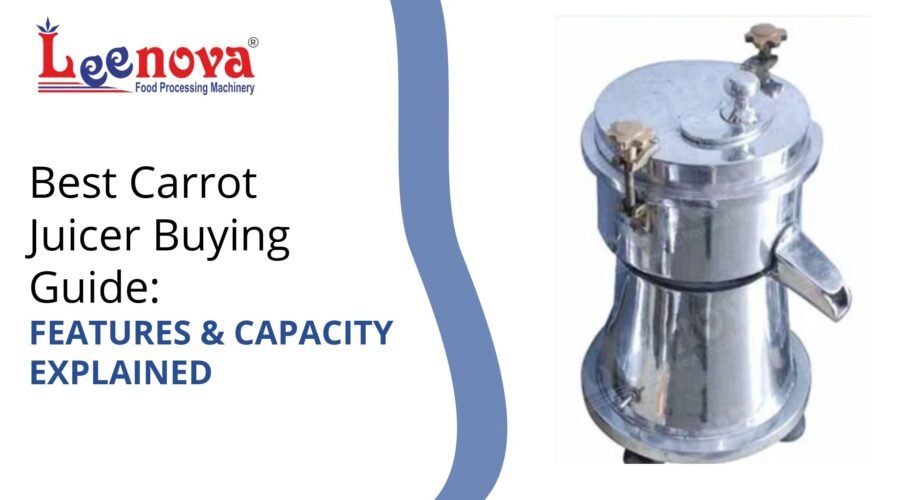
Most commercial kitchens lose 30-40% of their carrot juice yield to inefficient extraction, while home users abandon juicers within three months because cleaning takes longer than actual juicing. The wrong juicer type creates foam, oxidizes nutrients, or stalls mid-batch when processing fibrous vegetables like carrots and beets. This guide breaks down the three main juicer technologies, explains motor power and capacity metrics that actually matter, and shows how to match equipment to daily carrot volume—whether you’re juicing 10 glasses at home or 500 servings in a café. You’ll learn which features prevent common bottlenecks, how to calculate true cost per glass based on yield differences, and what safety standards apply to commercial operations.
Understanding Carrot Juicer Types
Three distinct technologies handle carrots differently. Centrifugal juicers spin blades at 3,000-10,000 RPM, shredding produce against mesh screens. Cold press (masticating) juicers use slow augers to crush and squeeze at 40-80 RPM. Commercial carrot juicers process 100-1,500 kg/hr through continuous-feed systems built for industrial output.
Centrifugal Juicers for Speed
High-speed spinning works well for made-to-order carrot juice at juice bars. A 1,000-watt centrifugal unit extracts 250ml from two large carrots in 20-30 seconds. The trade-off: heat from friction oxidizes nutrients faster, creating foam and reducing shelf life to 2-4 hours. Pulp exits wetter—roughly 50-60% moisture content versus 35-40% in cold press models.
Cold Press Juicers for Maximum Yield
Auger-based pressing extracts 15-30% more juice from hard produce compared to centrifugal methods. The slow crushing breaks down cellulose fibers without generating heat, preserving enzymes and extending refrigerated shelf life to 48-72 hours. Processing time increases to 2-3 minutes per batch, making cold press ideal for prep-ahead operations rather than counter service.
Commercial High-Capacity Machines
Stainless steel units with automatic feed hoppers handle whole carrots without pre-cutting, processing 200-500 kg/hr for juice plants and large canteens. Continuous discharge systems separate pulp while juice flows directly into collection vessels. These machines run 6-8 hours daily without overheating—impossible for domestic models rated for 20-minute duty cycles.
Key Features That Matter
Motor Power and Torque
Carrots are among the hardest vegetables to juice, requiring 800W minimum to avoid motor stalls. Wattage alone misleads—a 1,200W centrifugal motor runs at high speed with moderate torque, while an 800W cold press motor delivers higher torque at low RPM. Commercial units range from 2-5 HP (1,500-3,700W) for sustained heavy loads.
Feed Chute Design
Wide chutes measuring 2.5-3.5 inches accommodate whole medium carrots, eliminating 60-70% of prep time spent chopping. Narrow 1-inch chutes force more cutting but provide better control over feed rate, reducing jamming in some cold press designs.
Pulp Ejection Systems
External pulp containers allow continuous operation. Internal pulp baskets hold 500-800ml before requiring emptying—acceptable for home use but disruptive in commercial settings producing 50+ servings daily. Drier pulp indicates better extraction; quality machines leave pulp at 30-40% moisture rather than 60%.
Capacity and Throughput Explained
Domestic Ranges
Home juicers process 500ml-1.5L per session before needing cleaning. A typical cold press model extracts 250-300ml juice from 500g carrots in 2-3 minutes. Daily use of 4-6 glasses matches most household needs. Marathon juicing sessions overwork motors rated for 15-20 minute duty cycles.
Commercial Metrics
Juice bars measure capacity in kg/hr. A café serving 100 carrot juices daily needs 20-25 kg/hr throughput to avoid service delays during peak hours. Semi-commercial units handle 30-50 kg/hr; industrial machines reach 200-500 kg/hr. Continuous-duty ratings matter more than peak capacity—many machines throttle performance after 30 minutes to prevent overheating.
Juice Quality and Yield
Cold press technology extracts 20-30% more juice from the same carrot weight. At ₹40/kg for carrots, this difference saves ₹8-12 per kilogram processed—substantial for operations juicing 100+ kg monthly. Centrifugal juice oxidizes within 2-4 hours, developing off-flavors and browning. Cold press juice maintains color and taste for 48-72 hours refrigerated, enabling batch production.
Foam content differs dramatically. Centrifugal juicers generate 1-2cm foam layers requiring skimming or settling time. Cold press produces minimal foam—less than 2mm—for immediate service.
Usability and Maintenance
Assembly complexity determines whether equipment gets used daily or abandoned. Models with 3-4 main components take 30-60 seconds to set up. Designs requiring 8-10 interlocking parts intimidate new users and slow down multi-staff kitchens where rotating shifts operate equipment.
Cleaning time exceeds actual juicing time in 70% of home users’ experience. Smooth internal surfaces without sharp corners clean in 3-5 minutes under running water. Textured or ribbed components trap pulp fibers, requiring brush scrubbing and adding 10-15 minutes per session. This single factor drives equipment abandonment rates more than price or performance.
Material and Safety Standards
Food-grade stainless steel (SS304) resists corrosion from acidic carrot juice and withstands commercial sanitization protocols. Plastic juicing screens and pulp containers must be BPA-free; older models leach chemicals when processing acidic produce. Commercial operations require NSF-certified equipment meeting food contact surface standards.
Overload protection prevents motor damage when carrots jam the feed chute—common with undersized motors. Auto-shutoff engages when assembly is incomplete, preventing injury from exposed spinning blades. Three-phase motors on commercial units need proper grounding and 32A breakers minimum.
Matching Juicers to Use Cases
Home users juicing 2-6 glasses daily benefit from cold press models despite higher upfront cost. Better yield and longer shelf life offset the ₹15,000-₹25,000 investment within 8-12 months for families consuming juice regularly.
Juice bars serving made-to-order drinks choose centrifugal speed over cold press quality. Customers consume juice immediately, negating oxidation concerns. Front-of-house noise becomes the deciding factor—centrifugal units reach 85-90 dB versus 60-65 dB for cold press.
Large kitchens processing 100+ kg carrots daily need commercial stainless steel machines. Running three domestic juicers costs more in floor space, electrical infrastructure, and labor supervision than one properly sized commercial unit.
Common Buying Mistakes
Underestimating daily volume causes 80% of commercial juicer replacements within the first year. A café projecting 30 servings daily often hits 50-70 servings, overwhelming a 20 kg/hr machine. Small chutes force prep staff to spend 40-50% of their time chopping carrots instead of actually juicing.
Buyers focus on wattage listings while ignoring torque specs and duty cycle ratings. A 1,500W motor rated for 20-minute cycles performs worse in real commercial use than an 800W motor rated for continuous operation. After-sales service availability prevents 60% of commercial equipment failures—parts delays shut down juice programs for weeks.
Frequently Asked Questions
Q: Can I juice other vegetables with a carrot-focused juicer?
A: Yes. Machines handling carrots process beets, ginger, turmeric, and celery equally well. Soft fruits like oranges work but yield better results with citrus reamers. Leafy greens require cold press augers; centrifugal models spray more pulp than juice.
Q: How do I prevent carrots from jamming the feed chute?
A: Cut very thick carrots (over 1.5″ diameter) lengthwise. Alternate hard vegetables with softer items like cucumber or apple to push residue through. Never force produce—let the machine pull items down at its natural pace.
Q: What’s the real lifespan of commercial carrot juicers?
A: Properly maintained units last 5-7 years in daily commercial use. Blade assemblies need replacement every 18-24 months. Motors fail prematurely when operators exceed duty cycle ratings or skip daily cleaning, allowing dried pulp to create friction.
Q: Do higher RPMs mean faster carrot juicing?
A: Only for centrifugal models. Cold press juicers at 50 RPM extract more juice per minute than centrifugal units at 15,000 RPM because pulp exits drier. Speed alone doesn’t determine throughput—extraction efficiency and continuous operation matter more.
Q: Should I buy a multi-function food processor with juicing attachment?
A: No for commercial use. Dedicated juicers outperform attachments by 40-60% in yield and speed. Attachments suit occasional home use only. Commercial kitchens need purpose-built equipment meeting food safety codes.
Conclusion
Matching juicer type and capacity to actual daily carrot volume prevents the expensive cycle of undersized equipment, service disruptions, and premature replacements. Reach out with your typical daily kilogram requirements to get tailored equipment recommendations.
Leenova Kitchen Equipments manufactures ISO 9001:2015 certified commercial juicing equipment with food-grade stainless steel construction and continuous-duty motors. With 17+ years in food processing machinery, the company supplies carrot juicers from 30 kg/hr domestic models to 500 kg/hr industrial units, backed by factory warranties and nationwide technical support. Contact the product team for capacity sizing, voltage customization, and installation guidance—specify daily carrot volume and operating hours for accurate equipment matching.