

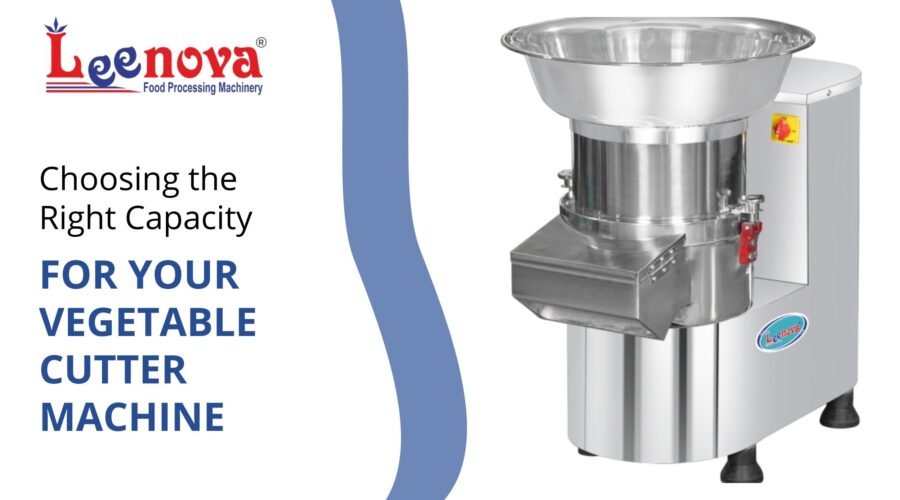
Most commercial kitchens buy vegetable cutters based on what fits the budget or what a supplier happens to stock, not what their prep schedule actually demands. The result: a 300 kg/hr machine sitting idle in a kitchen that processes 80 kg daily, or a 100 kg/hr unit forcing three cooks to hand-chop during lunch rush because the machine can’t keep up. Mismatched capacity wastes money, floor space, and prep time while creating bottlenecks that ripple through service. This guide explains how to calculate your real daily vegetable volume, translate it into hourly machine requirements, and choose the right automation level and blade setup. You’ll learn the capacity bands that match small kitchens, mid-scale restaurants, and food processing plants, plus the hidden factors—motor power, duty cycles, and changeover time—that determine whether a machine actually delivers its rated output in your operation.
Understanding Capacity Bands for Vegetable Cutter Machines
Vegetable cutter capacity is measured in kg/hr, but vendors rarely mention that those numbers assume continuous feeding, one vegetable type, and one cut style. Real-world throughput drops 20-30% when you switch between onions, tomatoes, and potatoes, or change from slicing to dicing mid-shift.
Three main capacity bands dominate the market:
- 50-150 kg/hr: Small kitchens, dhabas, cloud kitchens, and caterers processing 100-300 kg daily
- 150-400 kg/hr: Hotels, mid-sized restaurants, corporate canteens handling 400-800 kg daily
- 400-1000+ kg/hr: Food processing plants, central kitchens, institutional operations exceeding 1,000 kg daily
A useful rule: divide your daily kg requirement by 6-7 hours (not 10-12) to find the hourly capacity you actually need. That buffer accounts for cleaning, blade changes, and the reality that prep staff don’t feed machines at factory-test speeds.
Matching Machine Capacity to Kitchen Needs
Small Kitchens and Caterers
Operations processing 80-200 kg/day work well with 50-100 kg/hr semi-automatic machines. Manual loading keeps costs low while still saving 60-70% of hand-cutting time. These units typically use 0.5-1 HP motors and handle 2-4 vegetable types per shift without overheating.
Hotels and Restaurants
Mid-scale kitchens need 150-300 kg/hr machines with quick blade-change systems. At this volume, the time lost during manual blade swaps adds up—5 minutes per changeover means 30-40 minutes of downtime across a busy prep day. Look for machines with tool-free blade cassettes that swap in under 60 seconds.
Food Processing Plants
High-volume operations demand 400-1000 kg/hr fully automatic cutters with hopper feeds and conveyor discharge. These machines run 6-8 hours continuously, processing single vegetables in massive batches. The investment (₹2-8 lakh) only makes sense when daily volume exceeds 800-1,000 kg.
Key Features to Consider
Motor Power and Duty Cycle
Motor HP alone doesn’t predict performance. A 1 HP motor rated for continuous duty outperforms a 2 HP motor rated for 30-minute cycles. Vendors often hide duty cycle specs—ask explicitly. Underpowered motors overheat when processing dense vegetables like beetroot or raw potato, forcing frequent cooldown breaks that kill your effective capacity.
Automation Grade
Semi-automatic machines require manual vegetable feeding but automate cutting and discharge. Fully automatic units add hopper feeds and sensors that regulate flow. The automation gap adds ₹40,000-₹1,20,000 to machine cost. That premium rarely pays back unless you’re processing 400+ kg daily or facing high labor turnover.
Build Material
Stainless steel (SS304 minimum) resists corrosion from acidic vegetables like tomatoes and moisture from washing. Painted mild steel frames rust within 18-24 months in commercial kitchen humidity. The SS upgrade costs ₹8,000-₹15,000 but extends machine life from 3-4 years to 8-10 years.
Calculating Your Capacity Needs
Most kitchens underestimate vegetable volume because they track finished dish counts, not raw ingredient weight. A simple method:
- List your top 5-7 dishes requiring cut vegetables
- Note the raw vegetable kg per 10 portions
- Multiply by average daily covers
- Add 20% buffer for wastage and seasonal peaks
A 150-seat restaurant serving 200 covers daily with 60% of dishes vegetable-heavy typically processes 120-180 kg raw vegetables. That translates to a 25-30 kg/hr requirement if prep runs 6 hours—well within a 50-100 kg/hr machine’s range. Many operations over-buy based on peak festival days that happen 10-15 times yearly, leaving capacity unused 95% of the time.
Automation and Operator Considerations
Training and Supervision
Semi-automatic machines need 30-45 minutes of training; staff learn feeding speed, blade selection, and basic cleaning. Fully automatic units require 2-3 hours covering hopper calibration, sensor troubleshooting, and safety interlocks. High staff turnover (60-80% annually in many kitchens) makes simpler machines more practical despite lower absolute capacity.
Safety Features
Commercial vegetable cutters must include:
- Emergency stop switches within arm’s reach
- Blade guards that prevent finger contact
- Automatic shutoff when covers open
- Overload cutoffs for motor protection
These aren’t optional extras—they’re liability insurance. Budget models skip interlocks, saving ₹3,000-₹5,000 but exposing operations to injury claims and equipment damage.
Blade Types and Cutting Options
Standard blade sets cover 80% of kitchen needs:
- Slicing discs: onions, tomatoes, cucumber (1-10mm thickness)
- Dicing grids: potato, carrot, beetroot (5-20mm cubes)
- Shredding blades: cabbage, cheese, coconut
- French fry cutters: 6mm, 8mm, 10mm, 12mm strips
Machines offering interchangeable blades handle menu diversity better than single-function cutters, but each blade set costs ₹2,500-₹6,000. Plan blade inventory based on your top 3-4 cuts; rarely-used speciality blades justify hand-cutting instead.
Blade lifespan varies wildly: slicing discs last 8-12 months under normal use; dicing grids wear in 5-7 months due to higher stress. Stainless steel blades outlast carbon steel by 40-60% but cost double.
Common Mistakes to Avoid
Buying oversized machines because “we might expand” traps buyers in three ways. First, larger machines occupy 30-50% more floor space in already-tight prep areas. Second, higher-capacity motors draw more power even when running partial loads—a 3 HP machine uses 2.2 kW whether processing 50 kg or 300 kg. Third, cleaning time scales with machine size; a 400 kg/hr unit takes 25-30 minutes to clean versus 10-12 minutes for a 100 kg/hr model.
Ignoring blade-change frequency creates hidden downtime. Kitchens running 5-6 different cuts daily spend 20-30 minutes just on blade swaps if the machine requires tools and disassembly. That lost prep time compounds across weeks.
Overlooking service availability kills many investments. Machines needing proprietary parts or specialised technicians sit idle for 7-10 days during repairs. Confirm parts stock at local dealers and typical response times before buying exotic imports or obscure brands.
Frequently Asked Questions
Q: Can I use the same vegetable cutter for soft and hard vegetables?
A: Yes, but expect reduced efficiency. Soft vegetables like tomatoes need slower feed rates and sharper blades to avoid crushing. Hard vegetables like raw beetroot need higher motor power and duller, sturdier blades for impact. Switching between extremes multiple times daily wears machines 40-50% faster than processing similar-hardness vegetables in batches.
Q: How much does blade replacement cost over a year?
A: Plan ₹8,000-₹15,000 annually for a 100-150 kg/hr machine in daily commercial use. High-volume operations (300+ kg/hr) spend ₹20,000-₹35,000. These costs are often excluded from vendor quotes but represent 8-12% of total ownership cost over 5 years.
Q: What’s better: multiple small machines or one large machine?
A: One large machine wins for single-location, high-volume operations because of lower combined power draw, floor space, and maintenance. Multiple small machines suit multi-location setups, diverse menus requiring frequent changeovers, or operations wanting backup during breakdowns. The crossover point is around 250-300 kg daily volume.
Q: Do automatic vegetable cutters waste more vegetables?
A: Quality machines waste less—around 3-5% versus 8-12% for hand cutting—because uniform cuts mean fewer odd-sized pieces discarded during plating. Poor-quality cutters with misaligned blades or worn feed mechanisms can waste 15-20%, worse than manual cutting.
Q: How long does daily cleaning take?
A: Small machines (50-100 kg/hr): 8-12 minutes. Mid-size (150-300 kg/hr): 15-20 minutes. Large automatic units: 25-35 minutes. Machines with tool-free disassembly cut these times by 40%. Skipping daily cleaning increases breakdown frequency by 3-4x.
Conclusion
Capacity sizing isn’t about buying the biggest machine your budget allows. Calculate your daily kg requirement, divide by realistic prep hours, add a modest buffer, then match that to automation level and blade options your team can actually use. Share your daily vegetable volume and menu mix to get a tailored recommendation.
Leenova Kitchen Equipments manufactures commercial vegetable cutting machines from 50 kg/hr semi-automatic units to 300+ kg/hr automatic systems, all built with food-grade stainless steel and interchangeable blade options. With practical designs focused on easy cleaning, tool-free blade changes, and reliable motors suited to continuous commercial use, Leenova helps kitchens match equipment to real prep demands—not inflated specs. Contact the team with your daily vegetable volume, primary cuts needed, and kitchen constraints for equipment sizing that fits your actual operation and growth plan.