

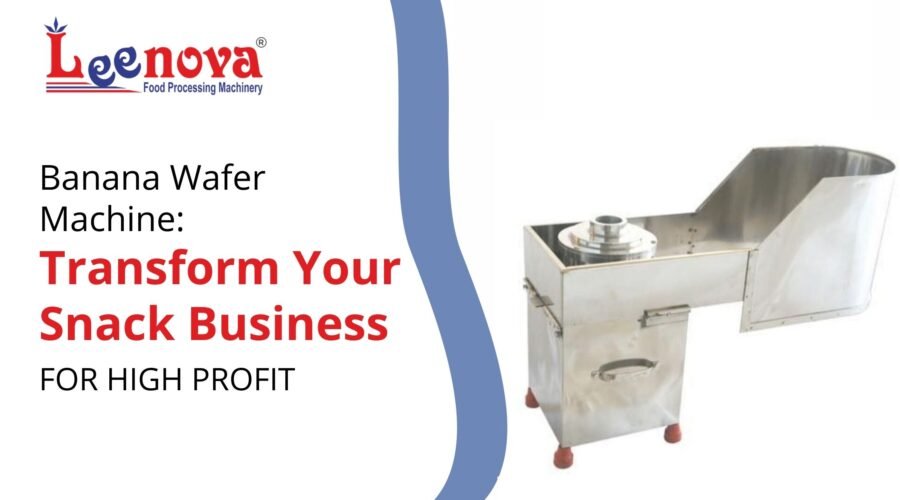
Small banana chip makers slice 8–12 kg of raw bananas per hour manually, paying ₹50–70 per hour for labor that delivers uneven thickness, breaks 15–20% of slices during handling, and creates a product that looks inconsistent in every batch. Scale beyond 40–50 kg daily output and you hit a ceiling: hire more slicers and watch labor costs eat 30–40% of revenue; push existing staff harder and quality falls apart during peak orders.
A commercial banana wafer machine processes 200–350 kg per hour with uniform slice thickness, eliminates knife-skill variation, and runs on single-phase power with one operator loading bananas. The right capacity and blade configuration turn a labor-heavy cottage operation into a scalable snack business that supplies retail chains, bulk buyers, and e-commerce platforms at profit margins 2–3x higher than manual production.
This guide covers machine types, slicing specifications, profit calculations, equipment integration, and the mistakes that waste money on undersized or poorly designed wafer machines. You’ll learn how to match capacity to growth targets, evaluate blade quality for consistent yield, and calculate breakeven volume for your first machine investment.
Why Banana Wafer Machines Deliver Higher Profits
Manual slicing costs ₹5–7 per kg in labor; machine slicing drops that to ₹0.80 – 1.20 per kg in electricity and maintenance. On 100 kg daily production, you save ₹420–580 daily—₹12,600–17,400 monthly—enough to recover a ₹25,000–35,000 machine in 60–90 days.
Uniformity matters more than speed for premium pricing. Hand-sliced chips vary 1.5–3 mm in thickness; machine-sliced wafers hold ±0.2 mm tolerance, delivering consistent frying time, color, and crunch. Retailers pay 15–25% more for visually uniform products because it photographs better, travels without breaking, and builds brand reputation faster than mixed-quality batches.
Types of Banana Wafer Machines
Manual and Semi-Automatic Models
Manual machines use hand-cranked rotary blades; one operator feeds bananas and turns the handle to produce 20–30 kg per hour. Semi-automatic units add electric motors (0.5–1 HP) that drive the cutting mechanism, boosting output to 100–200 kg per hour while the operator focuses on loading. Best for home-based businesses and small shops testing product-market fit before scaling.
Fully Automatic Machines
High-capacity units (250–350 kg per hour) with motorized hoppers, conveyor feeds, and speed controllers. Operators load bulk bananas; the machine auto-feeds, slices, and discharges into collection trays or directly onto fryer conveyors. These machines suit established snack brands running 8–10 hour shifts and supplying wholesale or B2B channels.
Key Specifications to Compare
Slicing Options
Round slices (for traditional Kerala-style banana chips), oval slices (for visual variety), and patta or long strips (for lengthwise cuts popular in Maharashtra and Karnataka). Blade plates swap in 5–10 minutes, letting you run multiple product SKUs on the same machine.
Slice Thickness Control
Adjustable from 1 mm to 4 mm depending on recipe. Thin slices (1–1.5 mm) fry faster, deliver more crunch, but break easily during packaging; thick slices (2.5–3 mm) create chewier texture, travel better, but absorb more oil and cost more to fry. Fixed-thickness machines lock you into one product type; adjustable designs offer flexibility as your market evolves.
Motor Power and Build
Semi-automatic machines run 0.5–1 HP motors on single-phase 220V; fully automatic units need 1–2 HP and may require three-phase power. Stainless steel construction (SS304) resists corrosion from banana starch, survives daily washing, and meets food safety norms. Cast-iron or painted bodies rust within 6–12 months in humid production environments.
Profit Calculations and Business Growth
Raw bananas cost ₹30–50 per kg; after peeling loss (25–30%), you get 700–750 grams of usable banana. Each kg of raw banana yields ~500–600 grams of fried chips after moisture loss. Total production cost (raw material + oil + labor + packaging + electricity) runs ₹120–150 per kg of finished chips.
Retail price for quality banana chips sits at ₹250–350 per kg; bulk wholesale moves at ₹180–220 per kg. Net margin ranges from 30–50% depending on channel mix. A 100 kg daily operation (70 kg finished chips) generates ₹5,600–11,200 daily gross profit at retail pricing—₹1.68–3.36 lakh monthly. Scale to 300 kg raw banana daily and monthly gross profit reaches ₹5–10 lakh, supporting regional distribution and retail chain contracts.
Integration with Other Equipment
Banana wafer machines feed into continuous frying systems (batch fryers or conveyor fryers rated at 50–150 kg per hour). Post-frying, chips pass through de-oiling centrifuges that remove excess oil (reducing fat content 20–30% and improving shelf life), then into flavoring drums for masala, salt, or pepper coating. Automated lines run slicing → frying → de-oiling → flavoring → cooling → packing in one continuous flow, cutting handling labor 60–70% versus batch-to-batch manual transfer.
Common Mistakes Buyers Make
Buyers choose machines based on current daily volume, ignoring growth and seasonal spikes during festivals when demand doubles or triples. A shop slicing 50 kg daily buys a 100 kg/hour machine, then struggles when Onam or Diwali orders hit 150 kg daily and the machine runs 12+ hours, overheating the motor and warping blades.
Ignoring blade quality leads to uneven slicing, high breakage, and wasted raw material. Cheap blades dull after 300–500 kg, forcing frequent sharpening or replacement (₹800–2,000 per blade set). Premium stainless steel blades last 2,000–3,000 kg before needing service, delivering lower lifecycle cost and better product consistency.
Frequently Asked Questions
Q: What capacity banana wafer machine do I need for a 50 kg daily operation?
A: A 100–150 kg per hour machine handles 50 kg in 20–30 minutes, leaving capacity for growth and peak days. Running below 50% capacity extends motor and blade life.
Q: Can one machine slice different vegetables?
A: Yes, most wafer machines handle bananas, raw plantains, potatoes, sweet potatoes, and tapioca with the same blade plates. Clean thoroughly between products to prevent starch cross-contamination and flavor transfer.
Q: How often do blades need sharpening?
A: Every 1,000–2,000 kg of throughput for semi-automatic machines; 3,000–5,000 kg for commercial units with hardened stainless steel blades. Inspect weekly; sharpen when slice thickness becomes uneven or banana pieces jam.
Q: What is the breakeven point for a banana wafer machine investment?
A: At ₹400–600 daily savings (labor + yield improvement), a ₹25,000–40,000 machine pays for itself in 40–100 days of operation. Add profit from increased output and breakeven shortens to 30–60 days.
Leenova Kitchen Equipments supplies banana wafer machines built for Indian snack entrepreneurs—stainless steel construction, capacities from 100 kg to 350 kg per hour, adjustable slice thickness, and blade plates for round, oval, and strip cuts. Visit leenovakitchenequipments.com or contact us for machine sizing, production planning, and integration guidance for complete snack lines from slicing through packaging.