

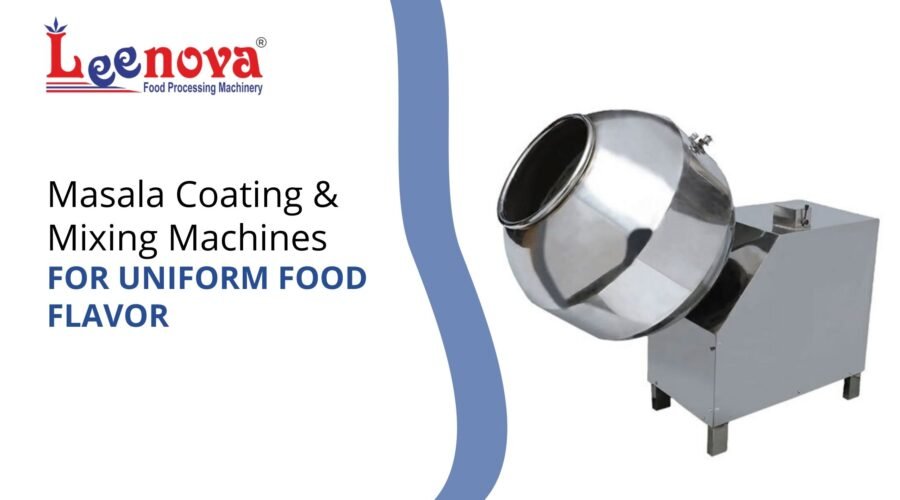
Manual masala coating creates flavor inconsistency that customers notice immediately. One handful of namkeen tastes over-spiced while the next tastes bland—the result of hand-mixing in tubs where some pieces get heavy coating while others barely touch the masala. Snack producers mixing 50-100 kg batches manually lose 12-18% of expensive seasoning to floor spills, tub residue, and uneven distribution. Quality control becomes impossible when every batch varies despite using identical recipes. Masala coating pans and mixing machines eliminate this variation completely. Rotating drums tumble products with controlled masala addition, delivering 95-98% coating uniformity across every piece in 3-5 minutes per batch. As commercial food equipment manufacturers since 2006, we’ve supplied coating and mixing machines to namkeen producers, spice blenders, and snack manufacturers needing repeatable flavor profiles. This guide explains how these machines work, coating pans versus powder mixers, capacity selection, operational benefits, and what features justify investment for consistent product quality.
Understanding the Two Machine Types
Coating Pans for Surface Seasoning
Coating pans are rotating drums that tumble finished snacks—namkeen, chips, fryums, nuts, popcorn—while applying oil and masala to their surfaces. The pan tilts for easy loading and discharge without breaking delicate products.
Drum rotation at 15-25 RPM creates gentle cascading action where every piece surfaces repeatedly, receiving proportional coating. Oil sprayed first acts as adhesive; dry masala added second sticks uniformly.
Coating pans suit operations adding flavor to already-cooked products. They handle fragile items like thin sev, puffed fryums, and crispy chips without crushing.
Powder Mixers for Spice Blending
Powder mixers use ribbon or paddle arms rotating inside fixed drums to blend dry masala powders, spice mixes, and seasoning bases. The mechanical action folds ingredients together until completely homogeneous.
These machines suit spice manufacturers, masala brands, and food processors creating seasoning blends for packaging or further use. Ribbon mixers achieve 95%+ uniformity in 5-8 minutes compared to 25-30 minutes manual mixing with inconsistent results.
How Uniform Flavor Happens
Controlled Tumbling Action
Coating pan drums rotate at speeds that lift product partially up the drum wall before gravity pulls it back down in a cascading pattern. Every piece cycles through the coating zone multiple times—typically 20-30 exposures in a 3-minute cycle.
This repeated exposure distributes seasoning evenly even when product pieces vary in size or shape. Manual mixing can’t replicate this mechanical consistency regardless of operator skill.
Timed Masala Addition
Good coating machines add oil and masala at specific intervals, not all at once. Oil sprays for 20-30 seconds while the drum tumbles, coating surfaces uniformly. Then masala feeds gradually while tumbling continues, sticking to the oil-coated surfaces.
Dumping all ingredients together—common in manual mixing—creates clumping where some pieces get overloaded while others stay bare.
Dead Zone Elimination
Poor drum design creates dead zones where product doesn’t tumble properly and gets under-coated. Quality pans use specific drum-to-baffle angles and rotation speeds that keep all material in motion.
Benefits for Snack and Spice Producers
Seasoning Cost Reduction
Manual coating loses 12-18% of applied masala to spillage, tub adhesion, and uneven distribution requiring extra seasoning to achieve target flavor. Machine coating reduces losses to 3-5% through contained application and precise metering.
At masala costs of ₹300-500 per kg and 100 kg daily production using 2-3 kg seasoning, that 10-13% savings recovers ₹30-65 daily or ₹900-1,950 monthly.
Product Breakage Prevention
Manual mixing in tubs or trays breaks 10-15% of delicate namkeen pieces through rough handling, stirring, and scooping. Gentle tumbling in coating pans reduces breakage to 2-4%, preserving product value.
Broken pieces become waste or get sold at discount, directly impacting profit margins. Lower breakage from mechanical coating improves net yield per batch.
Batch Consistency and Repeatability
Machine parameters—rotation speed, cycle time, oil volume, masala quantity—create repeatable processes. Recipe documentation becomes meaningful when equipment delivers identical results every time.
Manual processes vary with operator technique, fatigue, and judgment. Two workers following the same recipe produce noticeably different flavor intensity—a quality control nightmare.
Labor Time Savings
Coating 50 kg of namkeen manually takes 15-20 minutes of continuous stirring and tossing. A coating pan completes the same batch in 3-5 minutes while the operator handles other tasks.
For operations processing 200 kg daily across four batches, this saves 45-60 minutes of direct labor time per production day.
Applications Across Food Categories
Namkeen and Savory Snacks
Indian namkeen products—sev, bhujia, gathiya, chakli, chevdo, mixtures—require precise masala coating for authentic taste. Regional flavor preferences demand exact spice ratios that machines deliver consistently.
Coating pans handle these fragile products without breaking thin strands or puffed pieces. The 20-60 kg batch sizes match typical namkeen production volumes.
Western Snacks and Chips
Potato chips, banana chips, extruded snacks, pellets, and popcorn all require uniform seasoning. Customers expect every chip to taste like every other chip—machine coating delivers this while hand-dusting cannot.
Spice Powder Blending
Masala manufacturers blending turmeric, chili, coriander, and multiple spice components need thorough mixing where every gram contains proportional ingredients. Ribbon mixers achieve this homogeneity critical for consumer trust in packaged spices.
Capacity and Machine Selection
Small Production (10-25 kg batches)
Startups and small namkeen shops processing 40-100 kg daily need compact 10-25 kg coating pans. Four to five batches complete daily requirements in 20-25 minutes total machine time.
These machines measure 2-2.5 feet in diameter, fit in limited production spaces, and typically cost ₹18,000-28,000.
Medium Production (40-60 kg batches)
Established snack brands and spice blenders processing 150-250 kg daily require 40-60 kg capacity. Four batches handle daily volume in 15-20 minutes of mixing time.
Large Production (80-100+ kg batches)
Industrial snack manufacturers and spice companies need 80-100 kg mixers or multiple mid-sized units running parallel. These suit continuous production schedules where coating or mixing happens throughout shifts.
Key Features Worth Paying For
Food-grade stainless steel drums (SS 202 or SS 304) resist corrosion from salt, acids, and spice oils. Mild steel alternatives rust within months and contaminate products.
Tilting discharge mechanisms empty batches in 30-60 seconds without manual scooping that breaks product and wastes time. Manual discharge requires 5-8 minutes per batch.
Variable speed controls adjust rotation to match different products—fragile fryums need slower speeds than sturdy nuts. Fixed-speed machines limit versatility across product ranges.
Robust gear drives and proper motor sizing prevent strain during loaded operation. Undersized motors burn out within months of daily commercial use.
Operating Best Practices
Load coating pans to 60-70% of rated capacity for optimal tumbling space. Overfilling creates poor mixing; underfilling wastes cycle time and energy.
Sequence matters critically: load product first, spray oil while tumbling for 30-45 seconds, add dry masala gradually while continuing rotation for 2-3 minutes. Reversing this sequence or dumping ingredients together causes clumping.
Clean between flavor variants to prevent cross-contamination. Dried residue from previous batches taints new flavors and creates quality complaints.
Inspect spray nozzles weekly for clogs that create uneven oil distribution. Check gearbox oil monthly and lubricate bearings per manufacturer schedule.
Price and Investment Return
Coating pans range ₹15,000-45,000 depending on capacity and features. Powder mixers span ₹20,000-60,000 for commercial sizes. Stainless construction, tilting mechanisms, and speed controls add 30-40% over basic models.
A ₹25,000 coating pan processing 150 kg daily saves approximately ₹120 daily in reduced seasoning waste (10% × 3 kg × ₹400/kg) plus ₹60 in labor time savings. Combined ₹180 daily savings recover investment in 139 days—roughly 4.5 months.
FAQs
What is the difference between a coating pan and a masala mixer?
Coating pans tumble finished snacks while applying surface seasoning with oil and masala. Masala mixers blend dry spice powders using ribbon or paddle arms. Use coating pans for namkeen, chips, and snacks; use mixers for creating spice blends and seasoning powders.
How much seasoning waste can coating machines eliminate?
Manual coating loses 12-18% of applied seasoning to spills and uneven distribution. Quality coating pans reduce losses to 3-5% through contained application and uniform distribution. The 10-13% improvement directly reduces seasoning costs per kilogram of finished product.
Can the same machine handle different namkeen types?
Yes, coating pans handle various products from delicate sev to sturdy chakri by adjusting rotation speed and cycle time. Fragile items need slower speeds (15-18 RPM); sturdier products tolerate faster rotation (22-25 RPM). Clean thoroughly between product types to prevent cross-contamination.
What capacity coating pan do I need for 100 kg daily production?
For 100 kg daily output, select a 40-50 kg capacity pan running two batches. This provides buffer for busy days without overbuying capacity. Smaller 20-25 kg pans require four batches, increasing labor handling; 60 kg+ pans waste capacity on normal days.
How long do masala coating machines typically last?
Quality stainless steel coating pans and mixers last 10-15 years with proper maintenance. The rotating mechanism itself is durable; motors and bearings need standard maintenance. Gear drives require periodic oil changes; spray systems need nozzle cleaning to maintain performance over years of daily use.
Conclusion
Masala coating and mixing machines deliver 95-98% flavor uniformity, reduce seasoning waste by 10-13%, cut product breakage by 60-70%, and create repeatable recipes impossible with manual methods. The investment recovers within 4-6 months for most commercial operations through combined savings.
Leenova Kitchen Equipments manufactures masala coating pans and mixing machines designed for Indian snack and spice producers. Our range includes 20 kg, 40 kg, and 60 kg capacity coating pans with stainless steel drums, tilting discharge, and variable-speed motors for handling everything from delicate sev to sturdy chakri and chips.
Our coating pans feature food-grade SS construction, controlled rotation speeds (15-25 RPM adjustable), and practical tilt mechanisms that empty batches quickly without product damage. For spice blending, we offer ribbon-type powder mixers in 25 kg, 50 kg, and 80 kg capacities suited for masala manufacturers and seasoning producers.
Since 2006, we’ve supplied food processing equipment across India with a focus on machines that deliver consistent results batch after batch—the foundation of quality control in food production. All units include one-year warranty on motor and mechanical components, with spare parts readily available.
Ready to eliminate flavor inconsistency and seasoning waste in your production? Contact Leenova Kitchen Equipments today for specifications, capacity recommendations, and pricing on coating pans and masala mixers that transform product uniformity and recover their cost within months of daily operation.