

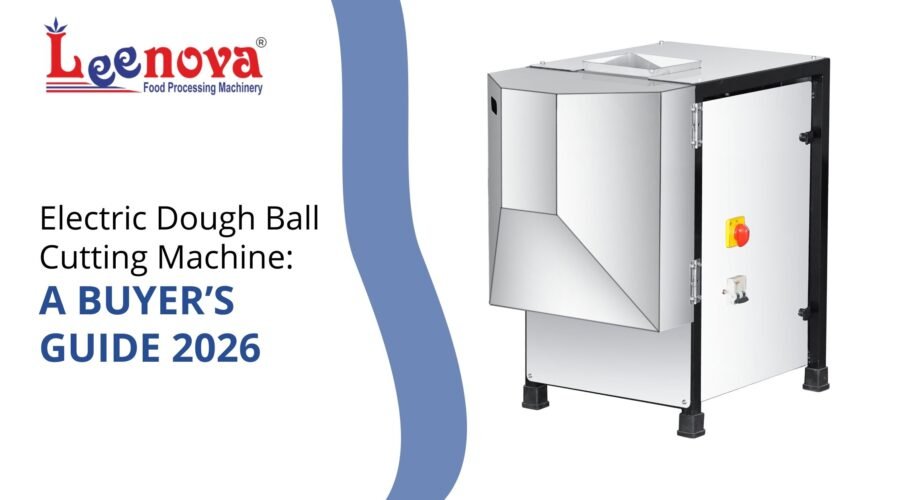
Manual dough cutting in commercial kitchens produces weight variations of 15-25% per ball, meaning one roti puffs perfectly while the next stays flat and chewy. For a tiffin unit preparing 2,000 rotis daily, that inconsistency wastes 8-12% of dough through over-portioning and rejects, while tying up two staff members for 3-4 hours in repetitive cutting and rolling. A well-matched electric dough ball cutting machine eliminates both problems. Compact tabletop units produce 1,000-2,500 uniform balls per hour with one operator; larger automatic machines reach 3,000-4,000 pieces per hour with ±0.1g weight deviation on industrial models. As Gujarat-based food equipment manufacturers since 2006, we supply dough cutting machines to commercial kitchens, roti lines, and central kitchens across India. This guide explains machine types, key specifications, appropriate capacity matching, common buyer mistakes, and what features matter most in 2026.
What Is an Electric Dough Ball Cutting Machine?
An electric dough ball cutting machine takes bulk dough and divides it into pre-set weight portions automatically using powered blades or pistons. The operator feeds dough into the hopper; the machine cuts, portions, and discharges uniform balls ready for pressing or rolling.
This differs from a full divider-rounder which adds a rounding stage after cutting, shaping each portion into a smooth ball. Cutting-only machines cost less and suit roti and puri lines where immediate pressing follows portioning; divider-rounders suit bakeries making buns, pav, and bread where a smooth, round ball improves final shape.
Types of Electric Dough Ball Cutting Machines
Compact Tabletop Electric Cutters
Entry-level machines handle 500-2,500 pieces per hour with a 20-50g weight range. They run on single-phase 230V power, weigh 60-80 kg, and fit on standard prep counters. These suit restaurants, tiffin services, and cloud kitchens producing 800-2,000 rotis or puris daily.
High-Throughput Automatic Machines
Larger automatic units process 2,000-4,000 pieces per hour across wider weight ranges—5g to 500g—handling everything from small puri portions to large bakery dough balls. They require 1.5-3.8 kW motors on three-phase 380-440V supply and weigh 150-320 kg. Central kitchens supplying multiple outlets need these machines.
Pneumatic vs Blade-Type Models
Blade-type electric cutters use rotating or reciprocating blades powered directly by the motor. Pneumatic models use compressed air pistons for cutting action and require a separate air compressor. Blade-type suits most Indian commercial kitchen setups; pneumatic models offer precise, gentle portioning for high-value dough products like laminated pastry.
Key Features and Specifications
Weight adjustability determines versatility. Fixed-weight machines limit menu flexibility; adjustable machines switch between puri (20-25g), roti (40-50g), and pav (60-80g) with dial or lever settings.
Essential features to check:
- Food-grade SS 304 contact parts for hygiene compliance and easy cleaning
- Adjustable weight range: minimum 20-50g for roti/puri lines; 20-500g for mixed-use kitchens
- Motor rating: 0.5 HP for tabletop; 1.5-3.8 kW for high-capacity units
- Compact footprint: 26×15×24 inch for countertop models; larger floor units need dedicated space with clearance
- Gearbox quality: direct-drive or worm-drive gearboxes outlast belt-drive systems under daily heavy loads
Benefits for Commercial Operations
Consistent portioning transforms downstream cooking. Uniform 40g roti balls pressed to the same thickness cook evenly in the same time—eliminating the batch variation that frustrates cooks and disappoints customers.
A counterintuitive finding: kitchens that switch to machine portioning often reduce total dough consumption by 10-15%. Manual cutting over-compensates for size variation by cutting large—operators unconsciously add extra dough to avoid small pieces. Machines cut exactly to target weight, eliminating this habitual over-portioning.
Labor shifts from repetitive cutting to value-adding tasks. One operator running a 1,000-piece/hour machine replaces three manual cutters while improving accuracy and reducing physical fatigue.
Applications
Electric dough ball cutters serve multiple product categories across Indian commercial kitchens:
- Roti and chapati lines: 40-50g portions for restaurants, messes, and roti manufacturers
- Puri production: 20-25g portions at 2,000+ pieces per hour for sweet shops and caterers
- Bakery items: 60-120g portions for pav, buns, pizza bases, and stuffed breads
- Indian sweets and snacks: gulab jamun, kachori, samosa dough, and donut bases
- Frozen and ready-to-cook products: central kitchens need machine-level consistency for standardized product across SKUs
Capacity Matching and Buying Considerations
Matching Volume to Machine Capacity
Track actual daily production over 2-3 weeks before selecting capacity. A kitchen making 1,200 rotis daily needs 600-800 pieces/hour capacity to complete cutting in 90-120 minutes during morning prep. A 3,000-piece/hour machine wastes capital on 1,200-piece requirements.
Electrical and Space Constraints
Single-phase models suit restaurants and tiffin units without three-phase electrical installation. Three-phase machines deliver more power and smoother operation for high-volume production—but require industrial wiring costing ₹8,000-15,000 extra if not already installed.
Confirm floor space before purchasing. Compact models (26×15×24 inches) fit existing prep stations; floor-mounted units (550×650×1460 mm) need dedicated space with clearance for operator movement and cleaning access.
Ease of Cleaning
Dough residue hardens within 2-3 hours if not removed. Machines with tool-less disassembly and smooth SS surfaces clean in 10-15 minutes. Machines with complex parts and narrow crevices take 40-50 minutes and still harbor residue.
Common Mistakes to Avoid
- Wrong dough consistency: too sticky clogs blades and jams the mechanism; too dry creates crumbling rather than clean cutting. Dough at 55-60% hydration works best for most Indian flatbread applications
- Overspec buying: purchasing 3,000-piece/hour machines for 500-piece daily requirements ties up capital without productivity benefit
- Ignoring cleaning discipline: dried dough buildup strains motors, introduces hygiene risks, and causes inaccurate portioning—daily cleaning is non-negotiable
- Skipping service network checks: a machine without local spares availability becomes expensive scrap when a gearbox or blade assembly fails
FAQs
What weight range do electric dough ball machines typically handle?
Compact tabletop machines cover 20-50g for roti and puri applications. Larger automatic units handle 5-500g, accommodating everything from small sweet portions to large bakery dough balls. Verify the specific adjustable range before purchasing; some machines have minimum weight limits that don’t suit small Indian sweet applications.
How accurate are electric dough ball cutting machines?
Entry-level electric cutters achieve ±2-3g consistency across batches. Industrial automatic dividers reach ±0.1g deviation, critical for bakeries where weight consistency affects final product texture and size. For roti and puri applications, ±2-3g accuracy is sufficient for consistent cooking results.
Can these machines handle whole wheat (atta) dough as well as maida?
Yes, both atta and maida doughs work well with electric cutters when prepared at correct hydration levels. Whole wheat dough requires slightly higher hydration (60-62%) than maida dough (55-58%) for clean cutting without blade sticking. Multigrain and millet flour blends work with the same machines if dough consistency is properly managed.
What maintenance do dough ball cutting machines require?
Daily: clean all contact surfaces, blades, and discharge chutes after each production run. Weekly: inspect blades for dullness or nicks and check belt or gearbox condition. Monthly: lubricate gearbox and bearings per manufacturer schedule; test emergency stops and electrical components.
Conclusion
Electric dough ball cutting machines eliminate weight variation, cut manual labor by 60-70%, reduce dough wastage by 10-15%, and enable consistent downstream cooking results. Matching capacity, weight range, and power requirements to actual daily volume determines how quickly the investment pays back.
Leenova Kitchen Equipments manufactures electric dough ball cutting machines designed for Indian commercial kitchen conditions—roti lines, puri production, tiffin units, and central kitchens. Our machines feature food-grade SS 304 contact parts, adjustable portioning from 20-50g, single-phase 230V motors, and compact countertop dimensions suited for existing prep stations.
We build for daily, long-hour use with robust gearboxes, easy-clean surfaces, and standardized components that our Gujarat-based service network can support quickly. All units come with one-year warranty on motor and mechanical parts, with spare blades and gearbox components available off the shelf.
Ready to eliminate manual dough cutting from your production workflow? Contact Leenova Kitchen Equipments today for machine specifications, capacity recommendations, and pricing on dough ball cutters that match your daily volume and product requirements.