

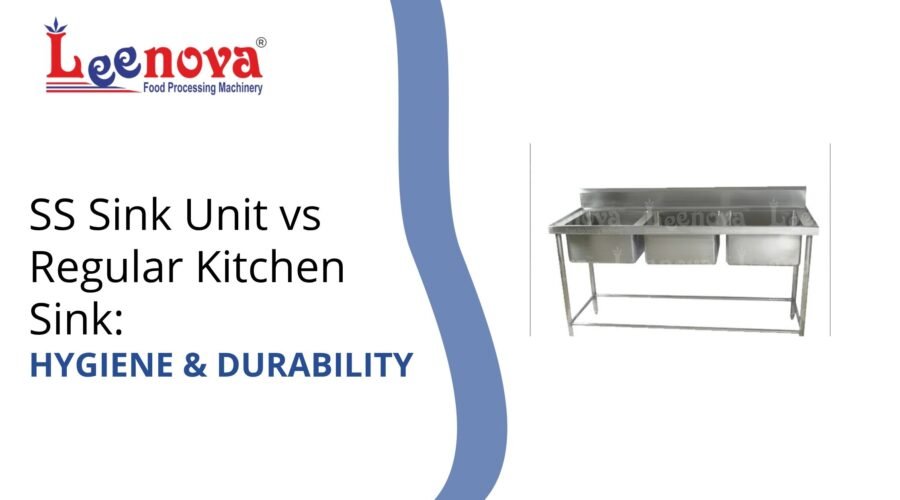
Restaurant kitchens, catering units, and cloud kitchens that install domestic ceramic or composite sinks replace them within 3–5 years—cracked basins from dropped pans, yellowed surfaces that trap grease regardless of scrubbing, and glaze that chips and harbors bacteria in crevices that no cleaning product fully reaches. The sink is the highest-contact surface in any food production environment, used 80–120 times daily in a busy commercial kitchen, and yet most buyers choose it based on showroom appearance rather than performance under sustained daily load.
A commercial SS sink unit lasts 15–30 years in continuous use, resists bacterial adhesion on its non-porous surface, tolerates boiling water, caustic cleaners, and impact from heavy cookware without cracking or discoloring, and meets FSSAI food safety requirements that ceramic and composite alternatives routinely fail to satisfy. The difference between a ₹3,000 domestic sink and a ₹12,000–25,000 commercial SS unit becomes clear within 18 months of operation when replacement and hygiene-compliance costs surface.
This guide covers material differences, hygiene performance, durability under commercial load, cost of ownership, installation, and the myths that lead kitchens to buy the wrong sink. By the end, you’ll know exactly which grade of stainless steel suits your use case and why commercial SS units outperform every alternative on total lifetime value.
Material Comparison
Stainless Steel Grades
Not all stainless steel performs equally in commercial kitchens:
- SS304 (18/8 alloy): 18% chromium, 8% nickel; resists most kitchen acids, cleaning agents, and moisture; standard for commercial food preparation sinks
- SS316 (marine grade): adds 2–3% molybdenum for superior chloride resistance; suited for seafood processing, heavy salt environments, and chemical-heavy cleaning protocols
- SS202: lower nickel content; cheaper but more prone to surface rust in humid, acid-heavy environments; not recommended for food-grade commercial use
Other Sink Materials
- Ceramic/porcelain: hard surface, attractive finish, but chips under impact and develops micro-cracks that trap bacteria and stain permanently
- Granite composite: durable and quiet, but absorbs pigment from turmeric, tamarind, and tomato-based sauces common in Indian commercial kitchens
- Cast iron: extremely heavy (18–25 kg per unit), requires structural reinforcement, and the enamel coating chips under commercial use
Hygiene Advantages of SS Sink Units
Stainless steel’s chromium oxide layer makes the surface non-porous at the microscopic level—bacteria, mold, and food particles cannot penetrate or colonize the base material. Studies on kitchen surface contamination consistently rank stainless steel among the lowest bacterial retention materials after wiping, compared to ceramic (which retains bacteria in glaze micro-cracks) and composite granite (which harbors bacteria in surface porosity).
Commercial SS sink units withstand sanitization with food-safe chlorine solutions, hot water above 82°C, and quaternary ammonium cleaners without surface degradation. Ceramic sinks suffer glaze erosion from repeated chemical sanitization within 18–24 months, requiring replacement before the structural basin fails. FSSAI food safety guidelines for commercial kitchens specify non-porous, easily cleaned surfaces at all wash and prep stations—SS304 satisfies this requirement; most domestic sink materials do not.
Durability in Commercial Use
A quality SS304 commercial sink unit lasts 15–30 years under daily commercial use. Ceramic sinks average 5–8 years before chipping or cracking compromises hygiene compliance; granite composite lasts 10–15 years but requires resealing every 2–3 years to maintain stain resistance.
Key durability differentials:
- Impact resistance: SS flexes on impact from heavy pans; ceramic and granite crack or chip
- Heat tolerance: SS handles boiling water and hot cookware without surface damage; ceramic can thermally shock and crack under rapid temperature changes
- Chemical resistance: SS304 withstands daily exposure to detergents, degreasers, and acid-based cleaners; composite materials degrade surface finish within 2–3 years
- Scratch behavior: SS develops surface scratches that blend into a uniform brushed finish over time; ceramic scratches expose porous underlayer that stains permanently
Noise, Installation, and Design
Commercial SS sink units produce more impact noise than cast iron or composite alternatives. Sound-dampening pads bonded to the underside of SS basins reduce noise 40–60%—standard on quality commercial units. In open-plan restaurant kitchens where noise carries to dining areas, under-basin insulation makes SS units acoustically acceptable.
SS sink units integrate into commercial kitchen layouts with standard plumbing connections and require no special structural support—unlike cast iron units that need reinforced countertops. Custom configurations (single bowl, double bowl, with drainer, with pre-rinse station) match specific workflow layouts without modification.
Cost Analysis
The upfront price gap between a domestic ceramic sink (₹2,500–5,000) and a commercial SS304 unit (₹12,000–30,000) creates a false economy. A ceramic sink replaced every 5 years over a 20-year kitchen lifespan costs 4x the material price plus installation labor each cycle. An SS304 commercial unit installed once, maintained correctly, runs the full 20-year period with no replacement cost and minimal maintenance beyond routine cleaning.
The hidden cost comparison over 20 years:
- Ceramic sink: ₹2,500–5,000 × 4 replacements = ₹10,000–20,000 + labor
- SS304 commercial unit: ₹12,000–30,000 × 1 installation = total cost with zero replacement
Common Myths About SS Sinks
“SS sinks scratch and look worn quickly.” Surface scratches on brushed SS finish blend over time into a uniform patina rather than becoming more visible like scratches on ceramic or painted surfaces. Light scratching is cosmetic, not structural, and does not compromise hygiene.
“All stainless steel is the same.” SS202 and SS304 look identical in showrooms but perform differently in humid, acid-rich commercial kitchen environments. SS202 rust spots appear within 12–18 months of daily exposure to salt, tamarind, and acidic cleaning agents. Always verify grade markings before purchase.
“Composite sinks are more hygienic because they’re non-scratch.” Composite granite is non-scratch but absorbs pigments and harbors bacteria in surface micro-porosity at a higher rate than SS304 under equivalent use conditions. The pigment absorption problem is particularly acute in Indian commercial kitchens where turmeric, tomato, and spice residues are daily constants.
Frequently Asked Questions
What SS grade should a restaurant kitchen specify for its sink units?
SS304 covers the requirements of most Indian commercial kitchens handling standard food prep, washing, and cleaning. SS316 is warranted in seafood processing facilities, coastal kitchens with high ambient salt, or operations using aggressive chlorine-based sanitizers at high concentrations. SS202 is not recommended for food-grade commercial use.
How thick should the steel be in a commercial sink unit?
16–18 gauge (1.2–1.5 mm) for commercial kitchen sinks handles daily impact from heavy cookware without denting. Thinner gauges (20–22 gauge, 0.8–0.9 mm) found in domestic units dent under commercial loading and amplify impact noise. Check gauge specifications—not just grade—before purchasing.
Can a commercial SS sink unit be customized for a specific kitchen layout?
Yes—commercial SS sink units are fabricated in single-bowl, double-bowl, and triple-bowl configurations with integrated drainer boards, pre-rinse spray arm brackets, and undershelf storage. Custom dimensions (width, depth, bowl depth) accommodate specific counter lengths and plumbing positions without requiring structural kitchen modifications.
How do I prevent rust spots on an SS304 sink?
Rust spots on SS304 are almost always surface contamination from iron particles (cast iron cookware, steel wool pads) rather than corrosion of the sink itself. Remove rust stains with a paste of baking soda and water or a diluted citric acid solution; avoid steel wool pads and bleach left in standing contact for extended periods.
Leenova Kitchen Equipment supplies commercial SS sink units fabricated in SS304 and SS316 to specification—single, double, and triple-bowl configurations, integrated drainer boards, sound-dampened basins, and custom dimensions for restaurant, hotel, catering, and institutional kitchen layouts. Visit leenovakitchenequipments.com or contact us for layout consultation, size specification, and pricing for commercial sink units built to food-safety standards and daily commercial demand.